Once every 4 years, Americans come together to partake in the viewership of the Women’s World Cup in which the U.S. Women’s National Team (USWNT) attempts to bring home the gold medal. 2019 was no different. Filled with star talent such as Alex Morgan, Megan Rapinoe and Alyssa Naeher, the USWNT once again put on a show for the Red, White and Blue. The Americans brought home the Gold medal by winning games against other power-house teams such as Spain, France, England, and The Netherlands. With the 2-0 win over The Netherlands in the final, featuring goals from Megan Rapinoe and Rose Lavelle, the USWNT had won consecutive World Cups and captured their 4th overall win. With a swagger not seen since the days of “The U” and a confidence unrivaled by any in the tournament, the USWNT quickly captured the hearts of Americans. As the team currently holding the most World Cup titles, the USWNT have cemented themselves as the team to beat amongst the global elite.
Quickly before we dive into this one, since not everyone has a great idea of how European soccer competitions, specifically the Champions League, are structured, we’ll give a quick run-down. This is pretty important background information to why this moment made our top 10 list for 2019. Feel free to skip this next paragraph if you have a decent understanding of the Champions League.
The UEFA Champions League is a tournament that sets out to crown one club as the champion of European club soccer. The structure is similar to the FIFA World Cup where 32 of the best teams from all of Europe are drawn into 8 groups. Then each group plays a home-and-home round robin schedule, and the top 2 teams from each group advance to the knockout stages. Each knockout fixture is determined over two matches, one game at each club’s home stadium, with the scores from both matches being aggregated to determine the winner. If the aggregate score is tied, then the first tie-breaker used to determine a winner is away goals. Whichever team scored more goals in their opponent’s stadium advances. If that doesn’t solve it, then extra time, and potentially penalty kicks, are utilized. The Champions League is *the* premier tournament in club soccer, with the final each year drawing 2-3x the viewership of the Super Bowl.
On to Liverpool and Barcelona. These two giants of clubs came into their semifinal tie with 5 Champions League titles a piece. This fixture was potentially the biggest headliner of the entire tournament as both teams were loaded with talent and play in two of the most famous stadiums in Europe. Barcelona, along with Lionel Messi, also featured two former Liverpool stars in its lineup in Luis Suarez and Philippe Coutinho who were sold for and €82M and €145M respectively. Liverpool, meanwhile, were seeking to avenge their loss to Real Madrid in the Champions League final in the season prior.
Liverpool played about as well as any team could in the intimidating atmosphere that is Camp Nou in Barcelona, but found themselves 3-0 down when the final whistle blew on the first leg of the tie on April 30. An opening goal by Suarez, followed by two from Messi (including an unbelievable free kick) were the difference.
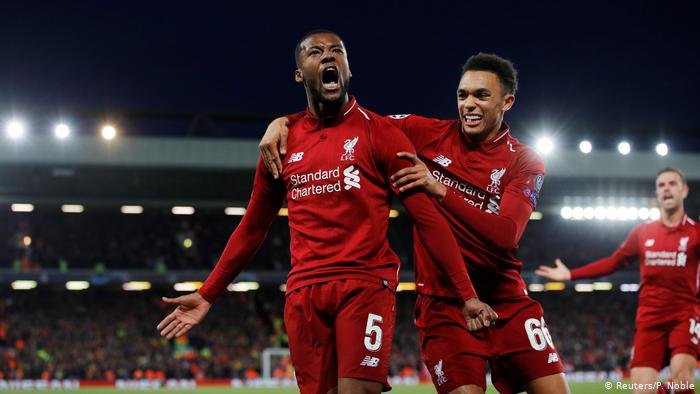
Heading back home, Liverpool would need to score at least 3 goals to force extra time, but if Barcelona were to grab an ever-valuable away goal, Liverpool would then need 5 to advance. This would be a reasonably difficult feat against just about any club, but needing to accomplish it against Barcelona without the services of two of their three attackers in Roberto Firmino and Mohamed Salah seemed impossible.Things got off to a favorable start though as Divock Origi tapped in a follow up after a great run from captain Jordan Henderson to make the score 1-0 at halftime. Midfielder Georginio Wijnaldum was subbed on at the start of the second half and had an immediate impact, scoring twice in quick succession to level the aggregate score by the 56th minute. Having climbed all the way back, the outcome would be decided in the last half hour of the game, plus extra time/penalties if needed. They would not be needed as it turned out. Some clever thinking by Liverpool right back Trent Alexander-Arnold on a corner kick will go down in history, as he took the corner quickly, and caught the Barcelona defense napping to find Origi alone in front of the net who guided the ball into the top corner. Leading 4-3 on aggregate in the 79th minute, Liverpool would grind out the final 10 minutes to complete one of the greatest comebacks in sports history.
The Reds would go on to defeat Tottenham Hotspur 2-0 in the Champions League final, collecting their 6th European title and first since 2005.



 Grad School Sports™